

The Brain-Eating Amoeba That Lives in Australian Dams, Bores and Backyard Pools
If your kids swim in the dam on your property, play under the garden hose on a hot day, or cool off in a pool that’s not properly treated, this is worth five minutes of your time.
Naegleria fowleri is a microscopic amoeba found in warm freshwater across Australia. It is rare, but when it infects a person, it is almost always fatal. Cases have been recorded in Queensland, Western Australia, New South Wales and South Australia, with recent deaths among children in rural Queensland linked to untreated bore water and farm dams.
NSW Health describes it as an organism that “infects people by entering the body when water containing the amoeba goes up the nose.” That can happen during swimming, diving, playing under sprinklers, or even using a hose. For full details refer to the NSW Health Naegleria fowleri fact sheet.
This post explains what parents on rural properties need to know, which water sources carry the highest risk, and the practical steps you can take to protect your family.
Where Does It Come From?
Naegleria fowleri thrives in warm, still freshwater. According to NSW Health, it grows best between 25°C and 46°C, which covers most of inland Australia through spring and summer. Any body of water that regularly exceeds 25°C can support it.
For families on rural properties, the water sources that carry the greatest risk are:
- Farm dams, especially shallow ones that warm quickly in summer
- Bore water rested in above-ground storage tanks or run through long above-ground pipes
- Rivers and creeks that run warm and slow in dry conditions
- Poorly maintained or under-treated swimming pools and spas
NSW Health notes that cases in Australia have specifically been linked to untreated private water supplies, including bore water and farm dams. Children and young adults appear to be more susceptible than older adults, and the infection cannot spread from person to person.
If your property draws water from a bore, you can find out more about what’s involved in treating it safely on our bore water treatment systems page.
How the Infection Happens
This is the part that surprises most people: you cannot get infected from drinking contaminated water. The amoeba cannot survive in the acidic environment of the stomach.
Infection only occurs when contaminated water is forced up through the nose, which is why children are particularly vulnerable. Kids dive in headfirst. They swim underwater, tumble through waves, play under hoses and sprinklers. Water goes up noses constantly.
Once Naegleria fowleri enters through the nasal passage, it travels along the olfactory nerve directly into the brain, where it causes Primary Amoebic Meningoencephalitis (PAM). The disease progresses rapidly. Initial symptoms including headache, fever, nausea and stiff neck typically appear within one to nine days of exposure, and death usually follows within around five days of symptoms starting. The survival rate is below 5%.
There is no reliable treatment. Medicines that work in laboratory settings have had very limited success in actual cases.
What About the Backyard Pool?
Residential swimming pools can also harbour Naegleria fowleri if they are poorly maintained or under-chlorinated. NSW Health is clear on this: a properly maintained and adequately chlorinated pool does not pose a risk. The problem arises when chlorine levels drop, water temperatures rise, and maintenance is inconsistent, which is more common than most pool owners realise over a long, hot Australian summer.
If your pool draws water from a bore or dam rather than a town supply, the risk profile changes again. See our page on UV water treatment for swimming pools for guidance on disinfection options beyond chlorine alone.
Can You Test Your Water for It?
Not easily, and not reliably. Identifying Naegleria fowleri in a water sample requires specialised laboratory testing. NSW Health advises that it should simply be assumed that any warm body of fresh water could contain the amoeba during warmer months.
That puts the emphasis on treatment and prevention rather than testing. The practical question for rural families is not “is it in our water?” but “what are we doing to ensure the water is safe before our kids get near it?”
How UV Disinfection Addresses the Risk
UV disinfection works by exposing water to ultraviolet light at a specific wavelength, which damages the DNA of microorganisms including bacteria, viruses and parasites. Once the DNA is disrupted, the organism cannot reproduce or cause infection. No pathogen is known to be immune to correctly dosed UV treatment.
For drinking water from bores or tanks, UV disinfection sits at the end of a treatment train that typically includes sediment filtration to remove silt and rust, followed by carbon block filtration to improve taste and clarity, and then UV exposure to destroy biological threats. This three-stage approach addresses both physical and biological contamination in one compact system.
One important note on UV dose: when Naegleria fowleri is in its hardier cyst form, a higher UV dose is required for effective inactivation. Choosing a system sized correctly for your flow rate matters. An undersized unit running too fast will not deliver sufficient UV dose to protect against the cyst form of the parasite.
UV Guard Systems for Residential and Rural Use
The three systems most relevant for rural residential applications are:
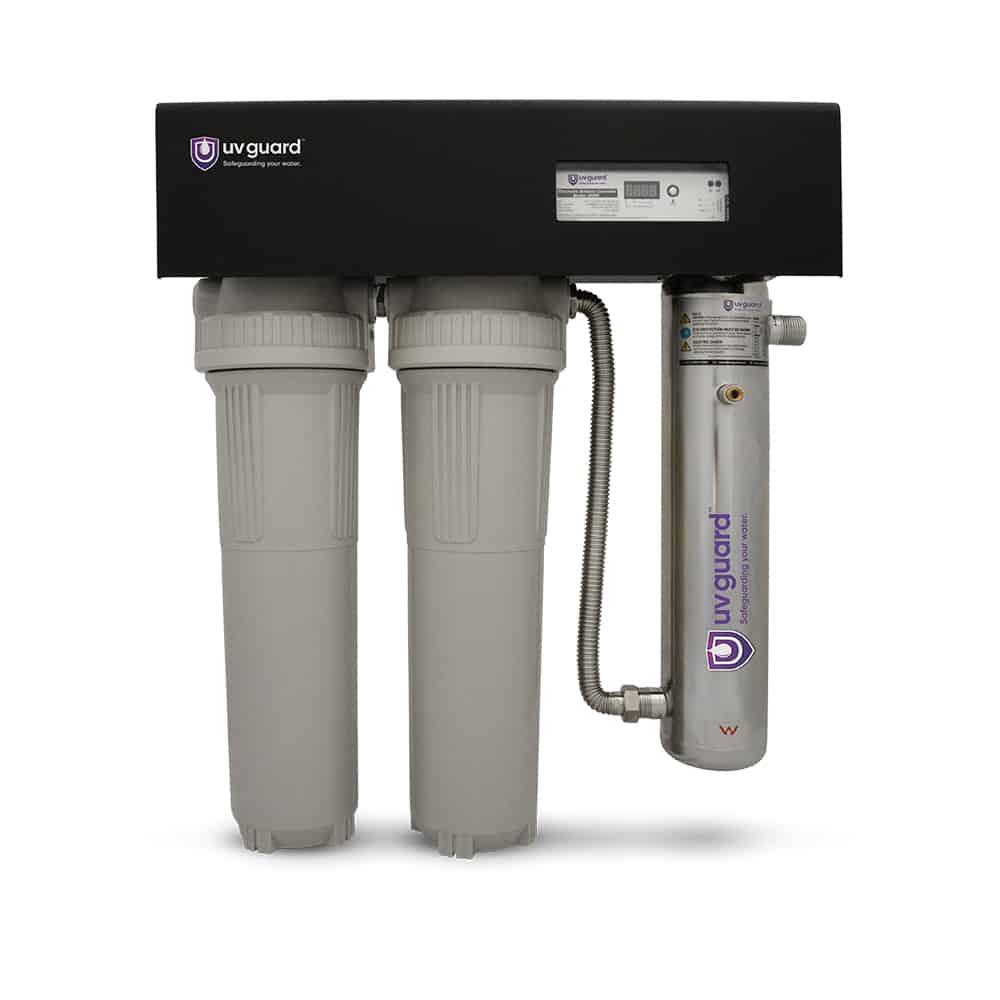
CWP-Series: Complete Water Purification for Bores, Tanks and Town Water
The CWP-Series is a compact, weather-resistant unit that handles the full three-stage treatment process in a single pre-assembled system. It uses a pleated washable sediment filter, a silver-impregnated antibacterial carbon block filter, and a 316L stainless steel UV reactor with a digital lamp controller.
It is Australian WaterMark certified and designed for outdoor installation, which matters on a rural property where the treatment system sits outside near the water source rather than under a kitchen sink. Available in 30W and 55W models to suit different flow rate requirements.

CWP-LED: Compact LED UV for Homes and Tight Spaces
The CWP LED uses LED UV technology rather than conventional mercury-based lamps. This removes the risk of overheating standing water, eliminates the need for fragile quartz components, and allows the unit to run on 12V DC or 240V AC. It is a smaller unit suited to situations where space is limited or where you want point-of-use protection at the kitchen tap.
The LED design also offers instant UV intensity with unlimited on/off cycles, unlike traditional lamps that need warm-up time. Rated for over one million litres over its service life.
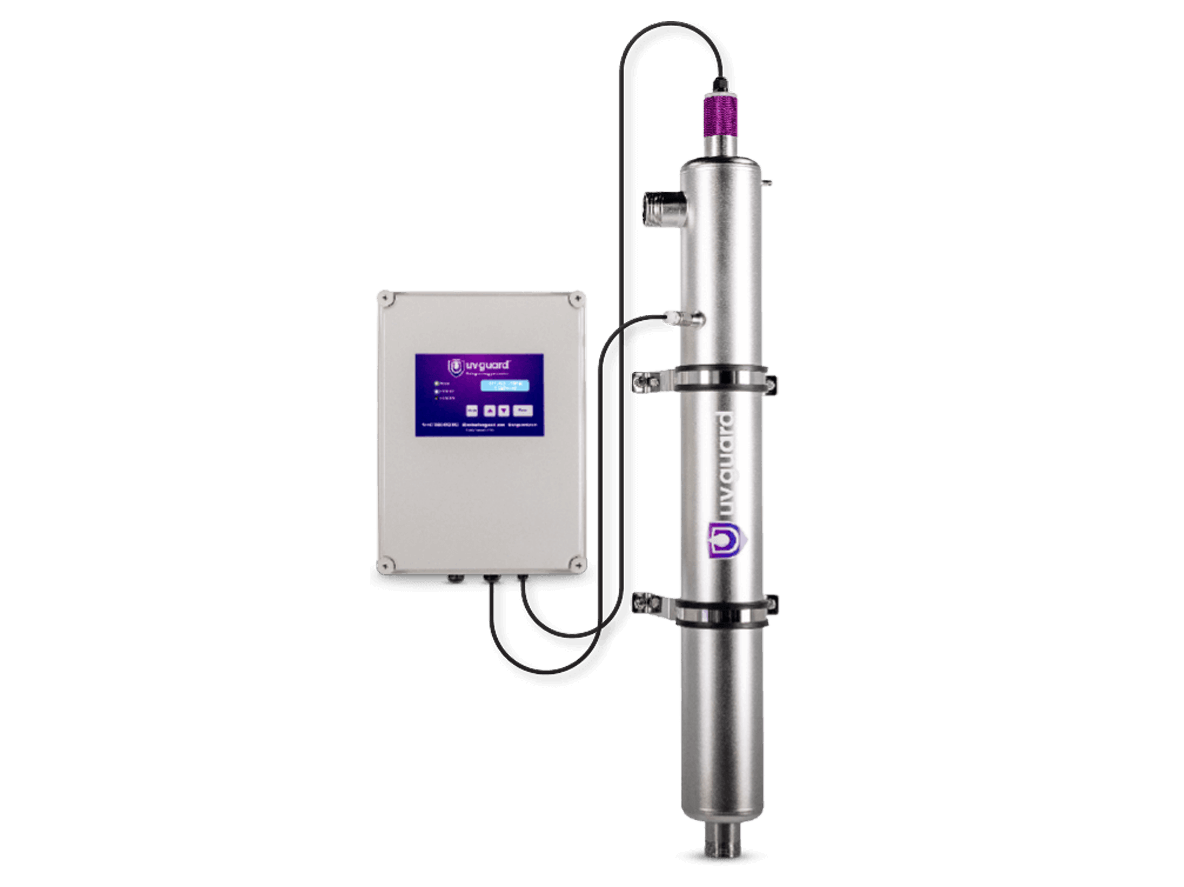
Armour Range: Whole-of-House UV for Homesteads and Larger Properties
The Armour-Series is available in seven models ranging from under-sink to whole-of-homestead capacity. The larger Armour models are designed specifically for homestead and swimming pool applications, handling flow rates from 86 up to 185 litres per minute at a 40 mJ/cm² UV dose.
For a rural property where bore or dam water serves the entire house, garden, and any outbuildings, the Armour Series provides whole-of-property disinfection at the point where water enters the distribution system. All models carry Australian WaterMark certification and use 316L stainless steel reactors.
Ballast Water Compliance: What Operators Need to Know Before They Sail
The IMO Ballast Water Management Convention came into full force in 2017 and has been progressively tightened since. Under its D-2 standard, vessels must treat ballast water to a biological performance standard before discharge, limiting the concentration of viable organisms by organism size class.
Individual flag states and port authorities enforce these requirements through inspections, and non-compliance can result in detention of the vessel, fines, and reputational consequences with port authorities. For operators in regular international trade, a documented and functional ballast water treatment system is no longer optional.
UV treatment is approved under the IMO convention framework and is widely specified by naval architects and marine engineers for new vessel builds and retrofits. It meets the D-2 biological standard without biocides, which simplifies both the regulatory approval process and the ongoing environmental compliance position of the vessel.
For vessel managers who are uncertain about whether their current operation falls under mandatory treatment requirements, the practical guidance is simple: treat ballast water before discharge as standard operating procedure. The regulatory framework is expanding, not contracting, and the cost of retrofitting a system is far lower than the cost of a compliance failure.
Common Questions from Rural Families
The Practical Step
Rural life in Australia means relying on water sources that town residents never think twice about. Bores, dams and rainwater tanks are practical and important. They also carry risks that a municipal chlorinated supply does not.
A properly installed UV disinfection system is not a precaution against a theoretical risk. It is a response to a documented, recurring problem that has taken children’s lives in regional Australia within the last few years.
If you are not sure where to start, call the UV Guard team on +61 2 9631 4900 or visit the UV Guard contact page to talk through your property’s water supply and get the right system specified for your situation.

UV Disinfection for Wastewater Treatment: Meeting Discharge Standards Without Chemical Residues
UV wastewater disinfection is the preferred method for municipal and industrial effluent treatment. It eliminates pathogens before discharge without the chlorine residue problems that affect receiving waterways.
-
UV Disinfection for Warm Water Systems and Legionella Control: Protecting Vulnerable People
UV disinfection is an effective supplementary strategy for Legionella control in building water systems, reducing bacterial populations to protect immunocompromised patients, aged care residents and high-risk occupants.


Get in touch
Contact our team for expert guidance on selecting the right UV water treatment system, sourcing compatible spare parts, or confirming the correct components for your existing setup. We can also assist with servicing requirements to help maintain performance and long-term reliability.
Newsletter
Stay up-to-date with our very latest news, technology, offers and events.