
Boat Water Treatment: A Practical Guide to UV Disinfection for Recreational and Commercial Vessels
Categories: Aquatics, Armour, Blog, Commercial, CWP-LED-Series, CWP-Series, LED-Series - Commercial, LED-Series - Residential, Residential, Wastewater
Most boat operators spend considerable time preparing for the season. Engine servicing, safety equipment, antifouling, insurance renewals. Water treatment rarely gets the same attention, and that is where problems start.
The water on a vessel is not one problem. It is four separate ones: the water people drink, the water going overboard, the water being reused on board, and the ballast water that regulators around the world are watching very closely. Each stream carries its own risk profile, and each one requires a treatment approach that actually works in a marine environment.
This guide is written for vessel operators and fleet managers who need practical answers, not a product brochure. We will look at where the risks sit, what the regulations require, and why UV disinfection has become the treatment method of choice for operators who want a reliable, chemical-free solution that fits within the constraints of life on the water.
Water on a Vessel Is Not the Same as Water on Land
Consider a charter yacht operating between island ports. The crew fills the drinking water tanks at the marina. Those tanks sit warm for days at a time. By the time a passenger pours a glass, the water has been sitting in an enclosed stainless or fibreglass tank, potentially at temperatures that encourage bacterial growth, with no ongoing treatment at the point of use.
Now consider the same vessel discharging grey water from the galley and heads into a protected harbour. Or a commercial passenger ferry taking on ballast water in one port and releasing it in another three hundred kilometres away.
These are real, everyday scenarios for anyone running a vessel, and they sit at the intersection of public health, environmental compliance, and operational practicality. The challenge is finding a treatment solution that addresses all of them without adding chemical storage, complex dosing systems, or significant power draw to a vessel that is already managing tight space and energy budgets.
That is precisely where UV water disinfection earns its place on board.
The Four Water Streams Every Vessel Operator Needs to Manage

Drinking Water: The Risk Inside the Tank
Potable water on a boat is more vulnerable than most operators realise. Unlike a building with constant pressure and flow through its pipes, a vessel’s water tank can sit stagnant for extended periods. Warm ambient temperatures, particularly in tropical or subtropical climates, create ideal conditions for pathogens including Legionella, E. coli, and Giardia to multiply.
The issue is not usually the water quality at the source. It is what happens during storage and transit to the tap. A UV disinfection system installed at the point of delivery treats every litre as it flows, eliminating 99.99% of harmful microorganisms without affecting taste, odour, or chemical composition. No residual. No overdosing. No ongoing chemical procurement.
For operators responsible for crew or passenger welfare, this is a straightforward risk management decision. Read more about UV disinfection for drinking water.

Grey Water and Black Water: Compliance Is Not Optional
Every vessel generates wastewater. Black water from the heads, grey water from showers and the galley sink. Both contain pathogens and nutrients that cause measurable harm to marine ecosystems when discharged untreated.
Discharge regulations vary by jurisdiction, but the direction of travel is the same everywhere: stricter controls, more no-discharge zones, and greater scrutiny of what vessels are putting into coastal and inland waterways. Marinas in many regions now require demonstrated treatment capability before a vessel can berth.
UV disinfection destroys the biological load in wastewater before it is discharged, without adding chlorine or other chemicals that create their own downstream environmental problems. It is a treatment method that satisfies regulatory requirements cleanly and leaves nothing harmful behind.
See how wastewater UV treatment works across different flow volumes and installation types.

Recreational Water: Spas, Plunge Pools, and Reuse Systems
Larger recreational vessels and commercial charter boats increasingly feature onboard spas, plunge pools, and water reuse systems. These closed-loop systems recirculate the same water repeatedly, which means any pathogen load that enters the system accumulates unless it is actively treated.
Chlorine is the traditional answer, but managing chlorine levels in a small, heated, heavily-used body of water on a moving vessel is genuinely difficult. Overdosing causes skin and eye irritation. Underdosing leaves the water unsafe. UV treatment removes that variable. The water is disinfected each time it cycles through the system, consistently and automatically, without any chemical inputs.
This matters particularly for charter operators and superyacht managers who carry passengers with expectations around water quality and comfort. Explore UV solutions for aquatic and recreational water applications.
Ballast Water Management: The Compliance Challenge With Global Reach
Of the four water streams, ballast water carries the most significant regulatory consequences for commercial operators.
Vessels take on ballast water to maintain trim and stability, particularly when sailing unladen. The problem is that this water contains whatever was living in the port where it was collected: microorganisms, larvae, algae, invertebrates. When that ballast is discharged in a different port, potentially thousands of kilometres away, those organisms enter a new environment where they may have no natural predators.
The consequences of invasive marine species introductions are well documented. Zebra mussels in the Great Lakes. The Northern Pacific seastar in Australian waters. The comb jellyfish throughout the Black Sea and Caspian. These introductions have caused billions of dollars in ecological and economic damage, and most were linked to ballast water discharge.
The IMO Ballast Water Management Convention, now adopted by more than 90 flag states, requires commercial vessels to manage ballast water to a biological standard that prevents live organisms from being discharged. Individual port states layer their own inspection and enforcement requirements on top of that framework.
UV treatment is one of the most widely adopted methods for meeting this standard. It physically destroys organisms passing through the system without introducing biocides, making it both effective and environmentally defensible. Learn more about UV disinfection systems and how they scale to the flow rates required for ballast water applications.
Why UV Disinfection Works So Well in a Marine Environment
UV disinfection is not new. Water utilities, food and beverage manufacturers, and pharmaceutical producers have relied on it for decades. What has changed is the technology. Compact LED-based UV systems now deliver the same treatment performance in a fraction of the space and at a fraction of the power draw of earlier mercury lamp systems.
That shift has made UV genuinely practical on board a vessel, where every decision involves a trade-off between performance, space, and power.
Here is what makes UV disinfection particularly well suited to marine applications:
No chemicals to store or manage. A vessel carrying chlorine or other disinfectants has a safety and logistics problem. UV requires no chemical inputs, no dosing equipment, and no specialist handling procedures.
No risk of overdosing. Unlike chemical treatment, UV cannot be applied in excess. The water receives its dose of ultraviolet light and the job is done. There is no residual concern and no danger of chemical contamination.
Compact and lightweight. UV-Guard systems are among the most compact in their class. They are designed to fit into the kind of confined equipment spaces that are standard on a vessel, without requiring custom installation work.
Low power draw with 12V and 24V DC compatibility. UV-Guard systems can connect directly to standard marine DC power supplies, avoiding the need for an inverter and the efficiency losses that come with it. For vessels with limited power generation capacity, this matters.
Instant on, automatic operation. LED UV systems reach full treatment intensity the moment water flows. A flow switch activates the system automatically, which means every litre is treated without any manual intervention or warm-up delay.
No moving parts and minimal maintenance. Beyond periodic lamp or LED element replacement, UV systems require very little maintenance. There are no filters to backwash, no chemicals to replenish, and no mechanical components subject to wear.
you are comparing treatment technologies, our overview of UV water purification systems covers the fundamentals in more detail.
UV-Guard Systems Suited to On-Board Applications
The right UV system depends on the vessel, the water volume being treated, and the specific application. UV-Guard manufactures systems across a wide performance range, and three in particular are well matched to marine use.
LED-Series: Compact Treatment for Recreational Vessels
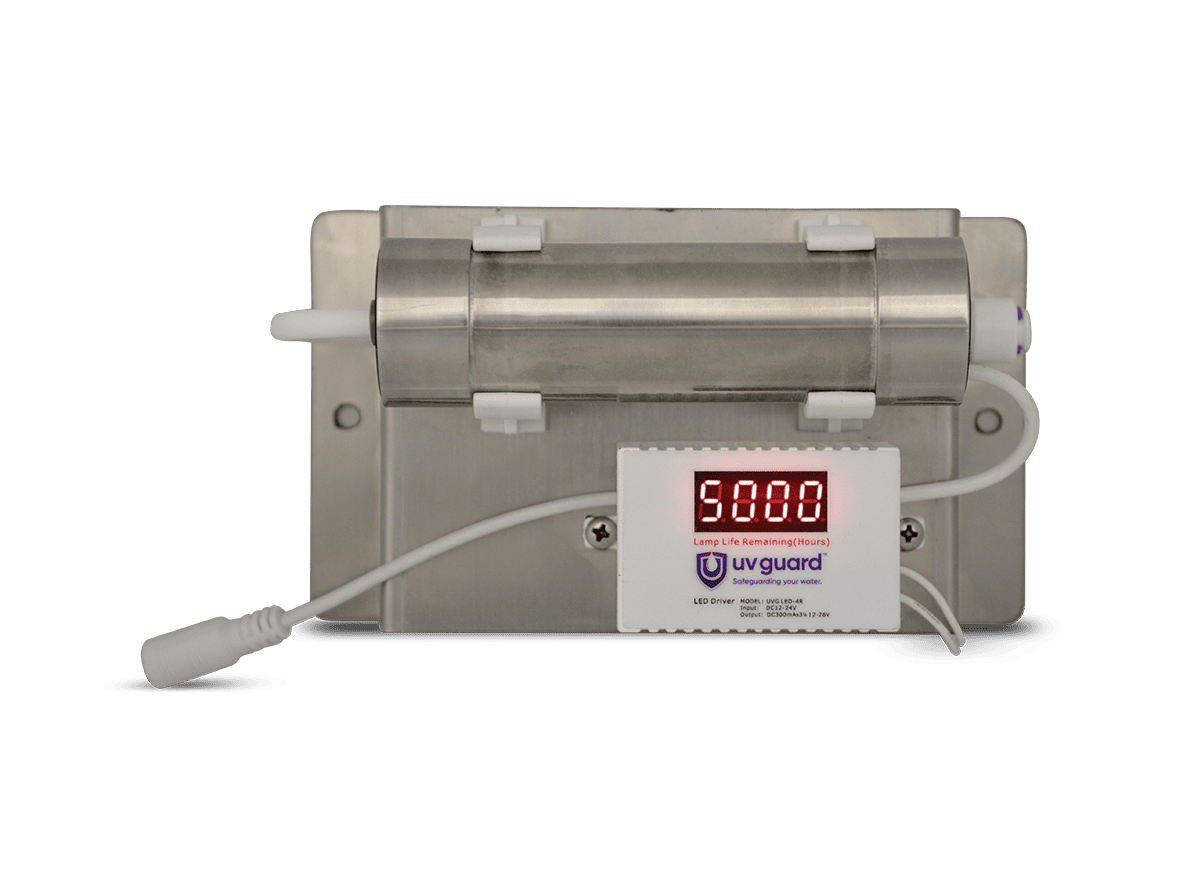
The LED-Series is UV-Guard’s most compact disinfection system and a practical choice for smaller recreational vessels where space and simplicity are priorities.
Built around mercury-free LED technology, it delivers 99.99% pathogen reduction including E. coli, Cryptosporidium, and Giardia at a flow rate of 4 litres per minute. There are no fragile quartz or glass components that could be damaged by the vibration and movement inherent in a marine environment. The LED element does not heat the water, which matters in systems where water temperature management is already a consideration.
The flow switch means the system only runs when water is moving. The LED life timer removes any guesswork about when the element needs replacing. For a cruiser or trailer boat where the drinking water supply is the primary concern, the LED-Series is a reliable and low-maintenance solution.
View full specifications: LED-Series product page

CWP-LED: Three-Stage Purification for Liveaboards and Charter Vessels
The CWP-LED takes a more comprehensive approach, combining sediment filtration, carbon adsorption, and LED UV disinfection in a single pre-assembled unit.
Stage one removes physical sediment and particulate from the water. Stage two passes it through a silver-impregnated carbon block filter that improves taste, odour, and clarity. Stage three delivers LED UV disinfection at 99.99% pathogen reduction. The entire process happens in a unit that measures 265mm wide and is available in 5″ or 10″ filter housing configurations.
The CWP-LED is compatible with both 12V DC and 240V AC power supplies, giving installation flexibility depending on the vessel’s electrical setup. The corrosion-resistant stainless-steel bracket is built for environments where moisture, salt air, and vibration are constants.
For a liveaboard vessel, a charter yacht with passengers, or a commercial vessel where crew drinking water quality is a duty of care issue, the CWP-LED delivers a complete treatment solution in a single installation point.
View full specifications: CWP-LED product page
Armour Range: High-Flow Performance for Commercial Vessels
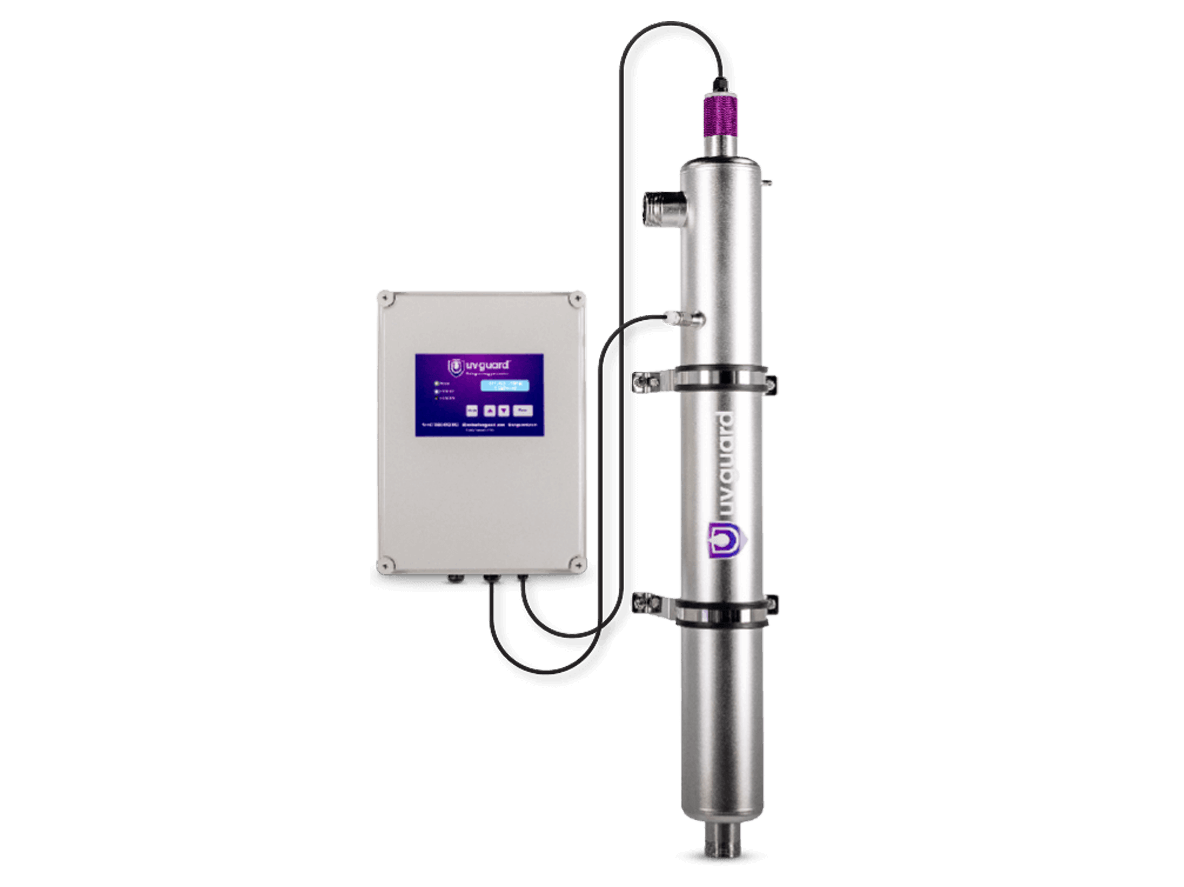
For commercial operators managing significant water volumes, whether for ballast treatment, large grey water discharge systems, or high-capacity potable water supply, the Armour Range is the appropriate choice.
The Armour is WaterMark certified (Level 1) and covers a broad flow range from 0.65 m³/hr up to 30.57 m³/hr at 40mJ/cm², across eleven models. It is built for high-pressure installations up to 16 bar, with a 316L stainless steel UV reactor that is glass-bead blasted and electro-polished for durability in demanding environments.
The internal flow mixer ensures that all water passing through the reactor receives uniform UV exposure, which is the basis on which compliance with biological treatment standards is demonstrated. The IP65-rated reactor housing provides protection in the kind of exposed, wet environments found in vessel engine rooms and utility spaces.
Optional controller configurations include UV intensity monitoring, Modbus integration for supervisory control systems, SMS fault notification, and remote on/off, giving fleet operators the oversight they need when a vessel is at sea.
View full specifications: Armour Range product page
Ballast Water Compliance: What Operators Need to Know Before They Sail
The IMO Ballast Water Management Convention came into full force in 2017 and has been progressively tightened since. Under its D-2 standard, vessels must treat ballast water to a biological performance standard before discharge, limiting the concentration of viable organisms by organism size class.
Individual flag states and port authorities enforce these requirements through inspections, and non-compliance can result in detention of the vessel, fines, and reputational consequences with port authorities. For operators in regular international trade, a documented and functional ballast water treatment system is no longer optional.
UV treatment is approved under the IMO convention framework and is widely specified by naval architects and marine engineers for new vessel builds and retrofits. It meets the D-2 biological standard without biocides, which simplifies both the regulatory approval process and the ongoing environmental compliance position of the vessel.
For vessel managers who are uncertain about whether their current operation falls under mandatory treatment requirements, the practical guidance is simple: treat ballast water before discharge as standard operating procedure. The regulatory framework is expanding, not contracting, and the cost of retrofitting a system is far lower than the cost of a compliance failure.
Frequently Asked Questions
Getting the Right System for Your Vessel
Every boat is different. Water volume, power supply, tank configuration, and the specific water streams you need to treat all affect which UV system is the right fit.
UV-Guard works with both recreational boat owners and commercial vessel operators to match the right system to the application. Whether you need a compact LED unit for a cruiser’s drinking water, a combined filtration and UV solution for a liveaboard, or a high-flow commercial system for ballast water compliance, there is a purpose-built option available.
Get in touch with the UV-Guard team to talk through your vessel’s requirements and find the right on-board water treatment solution before the season gets away from you.

UV Disinfection for Wastewater Treatment: Meeting Discharge Standards Without Chemical Residues
UV wastewater disinfection is the preferred method for municipal and industrial effluent treatment. It eliminates pathogens before discharge without the chlorine residue problems that affect receiving waterways.
-
UV Disinfection for Warm Water Systems and Legionella Control: Protecting Vulnerable People
UV disinfection is an effective supplementary strategy for Legionella control in building water systems, reducing bacterial populations to protect immunocompromised patients, aged care residents and high-risk occupants.


Get in touch
Contact our team for expert guidance on selecting the right UV water treatment system, sourcing compatible spare parts, or confirming the correct components for your existing setup. We can also assist with servicing requirements to help maintain performance and long-term reliability.
Newsletter
Stay up-to-date with our very latest news, technology, offers and events.